


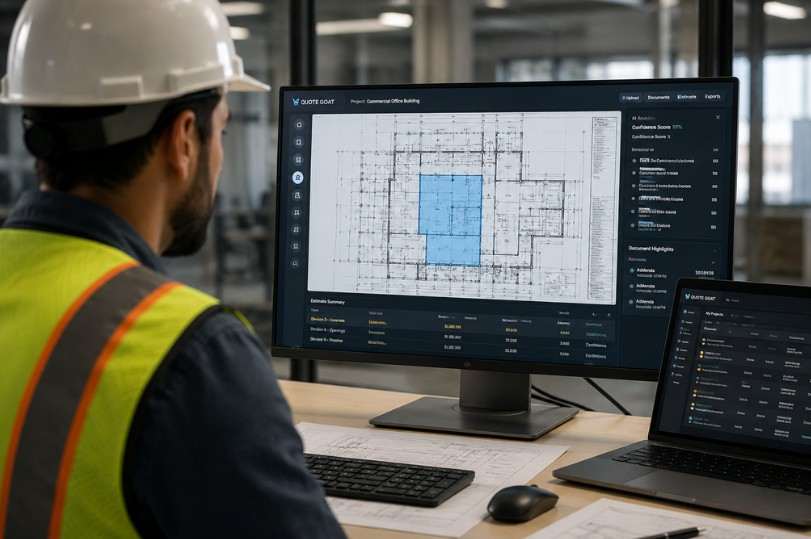
Meta: AI construction software helps contractors speed up takeoffs, reduce scope gaps, and manage bid docs with more consistency. Learn what it does, where it fits, and what to watch.
Keywords: AI construction software
Construction teams aren’t short on experience. They’re short on time. Bid calendars keep tightening, drawing sets keep growing, and the amount of project information that needs to be reviewed keeps climbing. A modern estimate can include hundreds of pages of plans, dense specifications, alternates, addenda, and scope notes that change more than once before anyone even breaks ground.
AI construction software is showing up in that pressure zone. Not as a magic button that produces perfect estimates, but as a way to help contractors and preconstruction teams process information faster, stay organized, and reduce the chances that something important gets missed. Used correctly, it’s less about replacing humans and more about giving them a stronger system for review, validation, and documentation.
What AI Construction Software Actually Means
AI construction software is a category of tools that uses machine learning to support tasks that are repetitive, document-heavy, and prone to bottlenecks. In construction, that usually means work tied to preconstruction and estimating, where teams need to interpret large plan sets and specs, extract relevant details, and assemble a bid package accurate enough to protect margin.
The important detail is that AI doesn’t “understand” a project the way a seasoned estimator does. It identifies patterns, extracts information, and helps structure the chaos. That’s why the strongest use cases tend to involve first-pass review and organization, followed by a human decision-maker validating everything that matters.
In practice, AI construction software often helps with things like:
- Sorting and organizing bid documents, addenda, and supporting files into a cleaner workflow.
- Highlighting potential scope gaps, conflicts, or missing details worth a second look.
- Speeding up early estimate drafts so teams can spend more time validating and strategizing.
- Creating a more consistent proposal structure, especially for inclusions, exclusions, and clarifications.
The end result isn’t “automatic pricing.” It’s a smoother path from raw bid documents to an estimate that a contractor can stand behind.
How It’s Changing Estimating And Preconstruction
The biggest shift is speed with structure. Estimating has always involved a mix of technical review, professional judgment, and a lot of manual processing. AI tools reduce manual processing, so estimators can spend more time on what actually protects profit.
For example, early-stage takeoff support can help teams reach a working estimate more quickly, which matters in competitive bidding environments. Faster first passes also make it easier to run scenarios, explore alternatives, and tighten proposal language without burning out the team.
AI tools also drive greater consistency in the preconstruction process. That consistency matters because many estimating mistakes don’t stem from a lack of skill. They come from fatigue, rushed review, or working across too many revisions. A system that flags issues, keeps documentation organized, and helps track changes can reduce “silent errors” that only surface later as scope disputes.
Another change is how teams handle revisions. Modern bidding includes constant updates. Some AI-driven workflows make it easier to compare versions, track changes, and prevent the classic mistake of pricing an older plan set.
None of this removes accountability. The contractor still owns the estimate. The benefit is that the contractor has better tools to keep the process under control rather than reactive.
Where AI Fits In A Real Contractor Workflow
Adoption usually works best when teams start small. The fastest way to create frustration is to bring in a new tool and try to rebuild the entire process around it. A better approach is to pick one high-impact use case, run a few real bids through it, and expand only after the team trusts the results.
Common fit points include:
- Initial bid package review to surface key notes, alternates, and scope flags early.
- Support for repetitive takeoff work, especially during early drafts and quick iterations.
- Scope review across plans, specs, and addenda to reduce missed requirements.
- Proposal drafting support for clarifications, inclusions, exclusions, and scope language.
- Revision tracking so teams can respond to addenda without losing control of the estimate.
The healthiest mindset is “AI assists, humans decide.” The tool can speed up the review process, help organize information, and highlight risks. The estimator still validates quantities, pricing, constructability, subcontractor coverage, and project approach.
What Contractors Should Look For Before Buying
AI construction software can look impressive in a demo. The real test is whether it holds up against the messy reality of live bid work. Contractors should evaluate tools against their own plan sets and workflows, not against a curated sample file.
A practical evaluation checklist includes:
- Can it handle the file types and plan formats the team receives most often?
- Does it support addenda and revisions without creating version confusion?
- Are the outputs easy to review and edit, or do they create extra cleanup work?
- Does it help expose scope gaps, inconsistencies, and missing details worth verifying?
- Will the team actually adopt it, or will it sit unused after the first month?
It’s also smart to define success before testing. If the goal is time savings, measure time. If the goal is fewer missed scope items, measure how many issues the tool surfaced that the team confirmed as real risks.
Limits, Risks, And Why Human Review Still Runs The Show
AI can speed up work, but speed can hide mistakes if the team stops validating. That’s the biggest risk. A clean-looking output can create false confidence, especially under deadline pressure.
There are also limits AI won’t solve:
- Poor quality drawings or incomplete specs still create uncertainty.
- Some scope items require interpretation rather than extraction.
- Local labor realities, productivity assumptions, and subcontractor coverage aren’t “in the documents.”
- Pricing strategy isn’t a pattern recognition problem. It’s experience, market conditions, and judgment.
A strong process treats AI output as an assistant’s draft, not a final answer. It still needs a senior review, especially for scope, clarifications, and pricing assumptions.
Data Privacy And Security Questions That Should Be Non-Negotiable
Construction data is sensitive. Bid documents, client details, and pricing logic are valuable information. Contractors should ask direct questions about how data is stored, protected, and handled.
Key questions include:
- Where is project data stored, and who can access it?
- Is the uploaded data used to train models, or is it isolated per customer?
- What permissions and access controls are available for internal teams?
- How does deletion work if a contractor wants data removed?
If a vendor can’t answer clearly, that’s a problem. Security needs to be a real part of the decision, not an afterthought.
A Simple 30-Day Adoption Plan That Doesn’t Blow Up The Team
A low-drama rollout is possible if expectations are realistic. The goal of the first month isn’t perfection. It’s proof that the tool creates measurable value.
A clean 30-day plan looks like this:
- Choose one use case, like first-pass review or proposal drafting support.
- Run two or three real bid packages through the tool.
- Assign one internal owner to collect feedback and track results.
- Compare the new workflow to the old one using time saved and issues caught.
- Keep human review mandatory before anything goes out the door.
If the tool delivers measurable gains without creating chaos, scaling it across more bids becomes a natural next step.
Frequently Asked Questions About AI Construction Software
What Is AI Construction Software Used For In Construction?
AI construction software is often used to help teams process bid documents faster and reduce manual work tied to preconstruction. It can support early plan review, document organization, and structured estimate drafting. Many tools also help teams surface scope gaps or inconsistencies that deserve attention. It works best as a support layer that strengthens human decision-making.
Does AI Construction Software Replace Estimators?
No, it doesn’t replace estimators in any practical sense. Estimating involves judgment, pricing strategy, constructability thinking, and market awareness, which can’t be reliably automated. AI can reduce repetitive workload and speed up early drafts. The estimator still retains final decision-making authority and accountability.
How Can AI Help Reduce Scope Gaps?
Scope gaps often happen when teams miss a note, overlook a spec detail, or fail to track a revision. AI tools can help flag items that appear inconsistent, are missing, or are likely to raise questions later. That said, the flags still need human validation. The tool’s value is that it makes it harder for important details to slip through unnoticed.
What Should Contractors Test In A Demo?
Contractors should test a tool using real project files, not a pre-built demo scenario. They should check how it handles large plan sets, addenda, and messy bid packages. It’s also important to see whether outputs are easy to review and edit. A tool that creates cleanup work can erase the time savings it claims to deliver.
Is AI Construction Software Accurate Enough To Trust?
It can be accurate in extracting information and speeding up early drafts, but it shouldn’t be treated as a final authority. Accuracy depends on document quality, project complexity, and how the tool is used. A strong workflow includes human review and validation for quantities, scope, and pricing assumptions. Trust should be earned through testing, not assumed.
What Types Of Companies Benefit The Most From These Tools?
Contractors who bid frequently, handle large plan sets, or deal with constant revisions tend to see benefits faster. Preconstruction teams that manage multiple bids at once also gain value from improved structure and faster first passes. Smaller contractors can benefit too, especially if they need help staying organized and consistent. The key is choosing a tool that fits the team’s real workflow.
How Should A Contractor Start Implementing AI Tools Without Disruption?
The cleanest approach is to start with one use case and test it across a few real bids. Measuring time saved and issues caught helps the team see whether it’s worth expanding. Assigning one internal owner keeps adoption organized. Keeping human review mandatory prevents avoidable mistakes during the learning curve.